

Montessori & Community
The Montessori approach is relevant to all children.
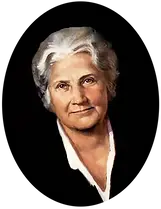
Dr. Maria Montessori demonstrated that children have an innate drive to learn. With the right environment, tools, and guidance, they can nurture curiosity, build confidence, and foster a lifelong love of learning.

We nurture children as valued citizens within world around us. Our environment fosters a deep connection to nature.
Indoors, children work with authentic Montessori materials that invite hands-on, purposeful learning. These materials aren’t separate from the outdoors — they are thoughtfully linked to real-life experiences beyond the classroom.
Outside children are given meaningful opportunities to apply their learning through daily community engagement and Forest School experiences.
By moving seamlessly between the indoor Montessori environment and the wider community children develop resilience, respect for nature, and a strong sense of belonging.
Growing Together

Bringing our Philosophy to Life...
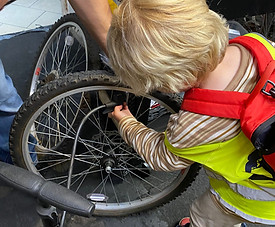
Engage with local businesses
& skilled neighbours
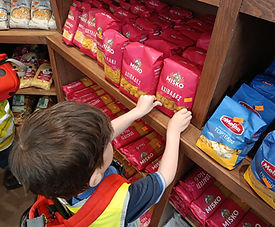
Participate in purposeful,
real-life tasks
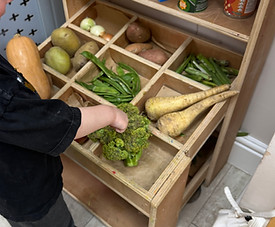
Hands-on
community activities
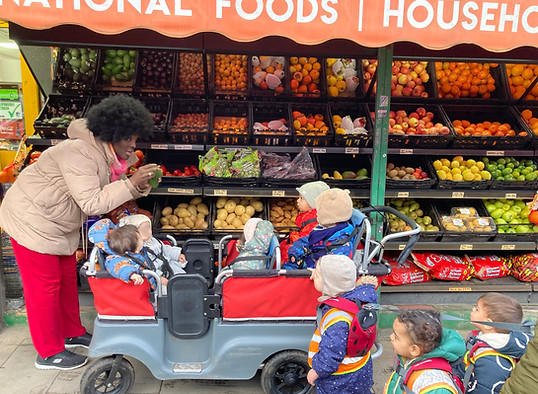

Learning within their local community, children naturally enhance all areas of their development.
Physical & Practical:
Improving motor skills through "real work"
Social & Emotional:
Building empathy, kindness, and communication
Cognitive:
Developing a "social awareness" and an appreciation for diverse cultures and roles
Montessori design is intentional & inviting
In Montessori, beauty is not separate from function. Our nursery is designed to be conducive to the principles of the Montessori method.
Arrangement and aesthetic supports concentration, independence and invites children to care for their environment.
A well prepared environment is about intention, where every material has a place and purpose - this forms part of the teaching itself.
When there is clarity in where things belong, children can focus their attention on meaningful work rather than navigating irrelevant clutter.

“The greatest sign for a teacher... is to be able to say,
The children are now working as if I did not exist.”
Maria Montessori
Educators
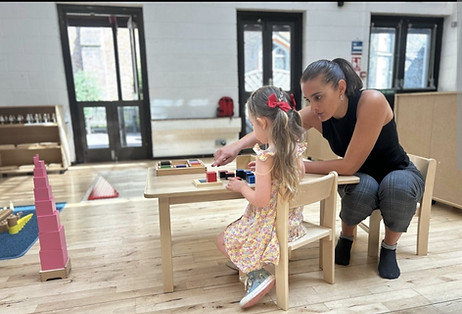
Our educators act as gentle guides, observing each child’s interests and developmental stage, and offering appropriate support without interrupting their focus.
Our educators act as gentle guides, observing each child’s interests and developmental stage, and offering appropriate support without interrupting their focus.

Key Elements of Montessori Ethos
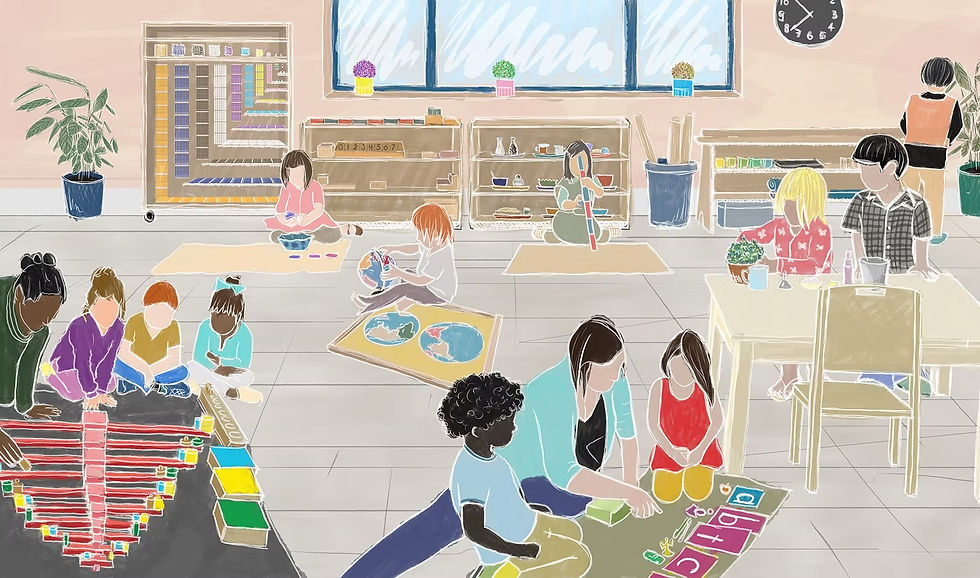
Child Centred
Our aim is to support each child’s individual learning journey, encouraging their interests at various ages and stages. Our teachers gently guide them to explore Montessori resources and encourage their independence.
Prepared Environment
Designed to encourage exploration and independence, our classrooms are designed to be inviting, resourceful and physically accessible. Children choose their own activities, promoting self-discipline and deep engagement in learning.
Respect for the child
A foundational pillar where our children are individuals with an innate, internal blueprint for their own development. We value and respect each child’s thoughts and feelings and in terms of language, this respect manifests in how we speak to them, about them, and around them.
Montessori materials
‘Developmental Aids’ act as learning tools to help children build skills, confidence, independence and introduce concepts. Categorised into five key areas within the classroom, these natural materials support specific aspects of a child development and encourage exploration, problem-solving and self-directed learning.
Independence
Activities are designed to be challenging yet achievable, promoting autonomy and a natural love for learning. Practitioners are on hand to step in when required but their role becomes a ‘guide’ rather than solely a teacher. We promote children to "Help me to do it by myself’’ with the goal of interdependence so that the child actually becomes a better member of the community.
Confidence
Self-assurance arising from a child achieving mastery over their environment and themselves through purposeful, independent work. Our teachers instil positive reinforcement and self directed learning to encourage this.
Holistic Development
We nurture and embrace the ‘whole’ child recognising the importance of their emotional, intellectual, social and physical growth. By honouring their natural rhythm and providing a peaceful space to explore, our curriculum inspires ‘awe and wonder’ that allows their entire being to flourish.
Sensitive Periods
Maria Montessori recognised that there are critical and precious times in a child's development when they are naturally drawn toward mastering a specific skill with more ease. During these phases, children show intense focus and concentration in specific areas. By skilfully observing these moments, our educators support these periods by providing appropriate resources and guidance, maximizing each child's inner potential.
The Absorbent Mind
Children effortlessly absorb their environment — language, culture, routines, attitudes. Learning is unconscious at first, then becomes more deliberate.
0–3 years: Unconscious absorbent mind – learning happens without effort or awareness.
3–6 years: Conscious absorbent mind – the child begins to choose, repeat, and refine learning.
Key Elements of Montessori Education

Practical Life
Fostering independence
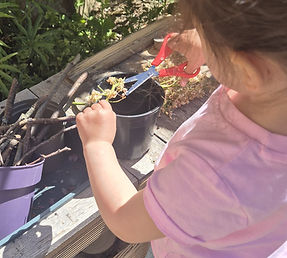
Practical Life activities involve teaching essential life skills through meaningful daily tasks fostering a care for themselves and respect for the world around them. Tasks such as cleaning, food preparation, tidying and gardening, develop coordination, concentration, and independence, which are essential for overall development.

Mathematics
a love of mathematical thinking
Our Montessori activities help children develop counting skills, understand numbers, and use mathematical language through hands-on learning and exploration. Our Montessori approach encourages children to move from concrete experiences to abstract thinking, helping them build a strong foundation in numeracy while fostering curiosity, concentration, and a positive attitude toward mathematics.
.jpg)
Sensorial Activities
Exploring the World Through the Senses
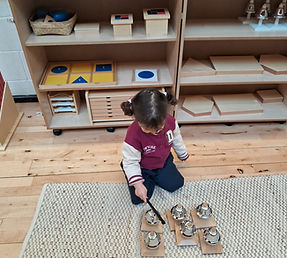
Children are natural explorers, and they learn best through direct sensory experiences. Our sensorial materials encourage them to engage with textures, sounds, shapes, colours, and patterns, helping them make sense of the world in a hands-on, meaningful way. Each material is thoughtfully designed to refine observation, enhance problem-solving skills, and develop attention to detail, while laying a solid foundation for future learning and discovery. Sensorial materials help children refine their senses through sorting, matching, and comparing objects based on size, shape, texture, sound, and colour. Engaging their senses enhances observation skills and intellectual growth.
Understanding the World
connecting with our global community
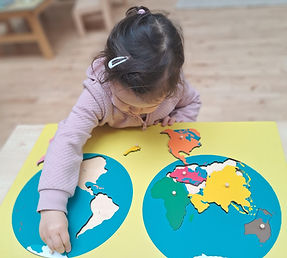
Children are naturally curious about the world around them. Through cultural exploration, geography, nature studies, and community experiences, children develop a sense of belonging to something bigger than themselves. Cultural activities expose children to music, stories, art, geography, history, science, and nature. These experiences foster a sense of community and appreciation for different cultures helping children develop a well-rounded worldview. We celebrate diversity, kindness, and respect for different cultures, helping children develop empathy and understanding of the wider world.

Language Development
voice & love of communication
Early language development is nurtured through storytelling, conversation, songs, and rich vocabulary experiences. Children are encouraged to express their thoughts, share ideas, and communicate confidently within a supportive environment and the extended community. Montessori language activities enhance vocabulary and language skills through phonetic sounds, reading, and writing. Tools like sandpaper letters and movable alphabets make learning to read and write fun and interactive.


“Never help a child with a task at which he feels he can succeed.”
Maria Montessori
